Why this matters more on a commercial property
On a house, a fall from a ladder hurts one person. On a commercial property, a fall from a roofline, a lift tipping in a parking lot or an overloaded circuit in a lobby becomes the property's problem: liability, insurance claims, a tenant complaint or an incident report for the board. Commercial Christmas light installation is work at height on a working property, and it should be treated that way.
Most of the risk is managed before anyone arrives on site. The right installer has the right coverage, the right equipment, a plan for access and power, and product that will not fail in January. The wrong installer has a pickup truck, extension ladders and a receipt from a big-box store.
This guide lists what to ask, what the answers should be and why. It is written from the side of the crew that does the work, so it is specific. We are based in London, Ontario and work across Southwestern Ontario, the GTA and Hamilton-Niagara, and these are the questions our clients ask us.
Insurance and WSIB: the paperwork that protects you
Ask for a certificate of insurance naming your property or management company, and ask for a WSIB clearance certificate. In Ontario, a contractor working at height on your property without WSIB coverage can leave the property owner exposed if a worker is injured. Reputable installers provide both documents on request, usually at proposal stage so vendor setup is done before install week.
Our crews are insured and WSIB-compliant and we supply both documents as a matter of course. If an installer hesitates, cannot name their insurer or says they are covered under a home policy, that is your answer. Ask for the documents in writing and keep them with the vendor file for the season.
Also ask who actually does the work. Some companies sell the job and subcontract the install. That is not always a problem, but you need to know whose insurance and WSIB apply to the person on your roof. We install with our own crews. Ask the same question about takedown in January, which is sometimes handed to a different crew.
- Certificate of insurance naming your property
- WSIB clearance certificate, current
- Confirmation that the installer's own crews do the work
Lifts, ladders and working at height
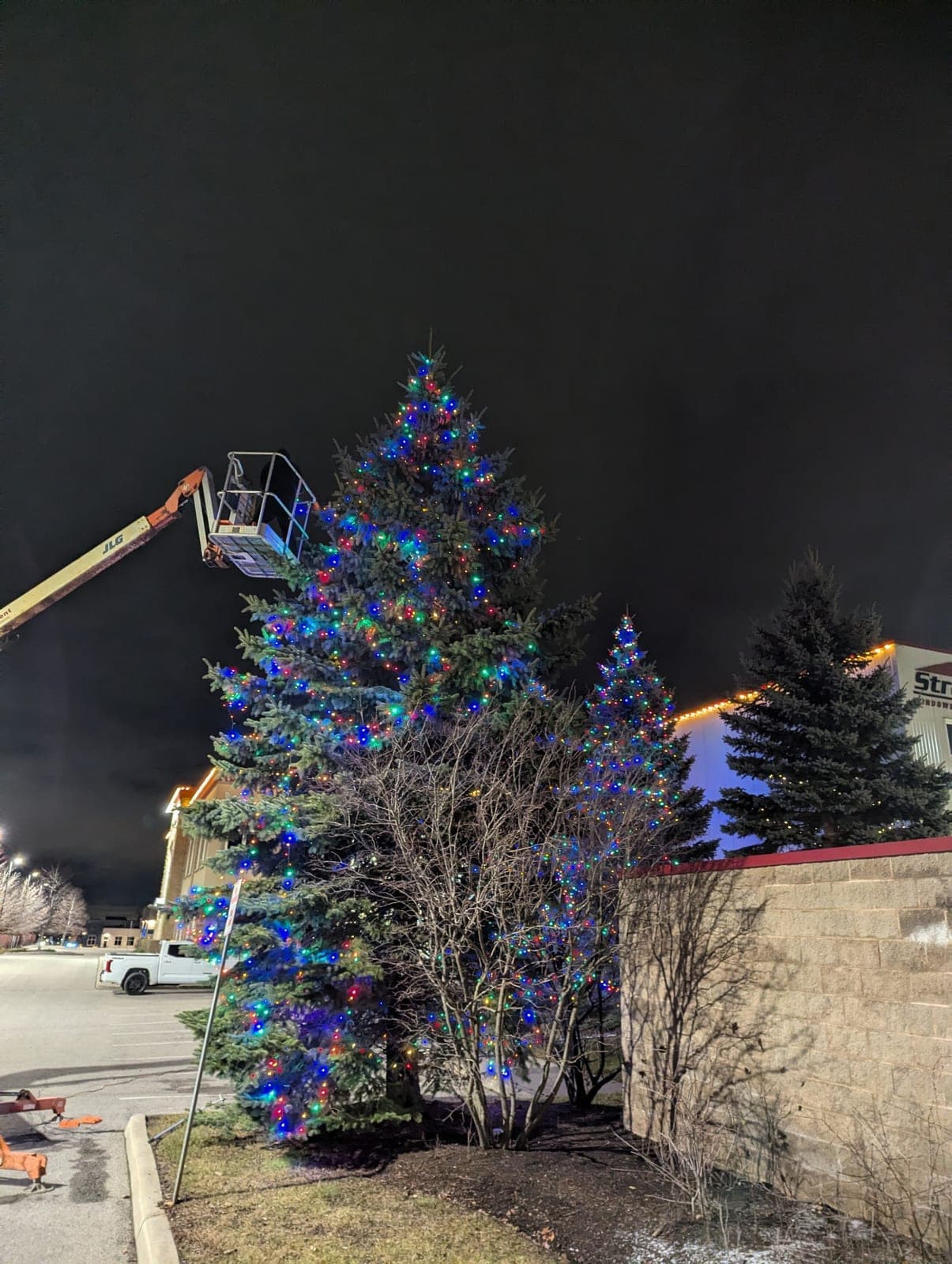
Rooflines, porte-cochères, canopies, columns and tall trees should be installed from a bucket truck or aerial lift, not from an extension ladder leaning on a gutter. Lifts are safer, faster and let the installer place lights properly along a soffit or wrap a tree all the way up rather than as far as a ladder reaches.
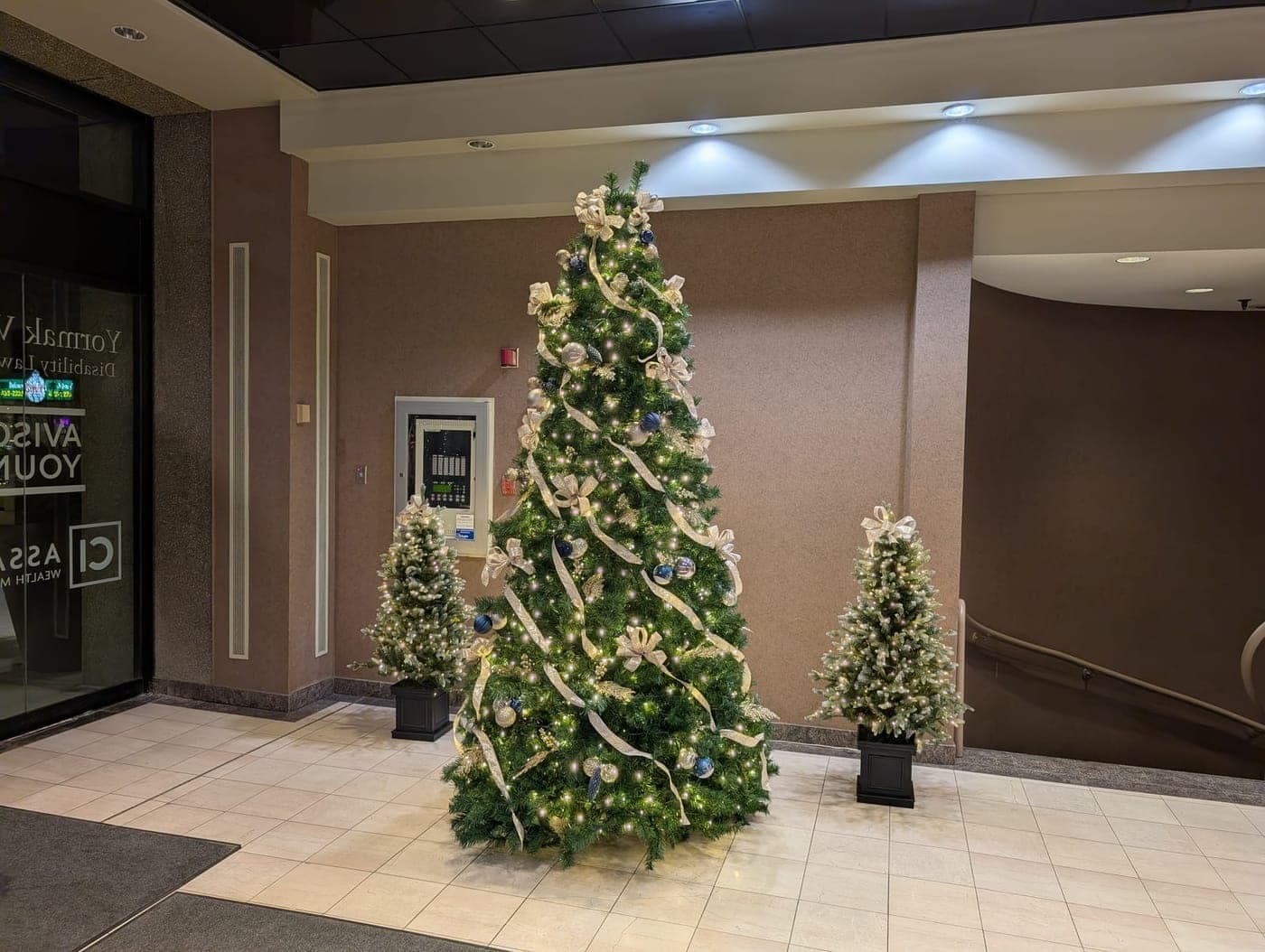
Ask what equipment will be used and where it will be positioned. At the site visit we check ground surface, slope, overhead wires and how to keep walkways and lanes open while the lift is in use. For atrium trees we use indoor-rated lifts and check floor loading and access routes. Lift requirements are a real cost driver, which is why we price them up front rather than discovering them on install day.
Ask about weather limits too. Lifts do not go up in high wind, and roofs are not walked in ice. A good installer will tell you that an October install in mild weather is safer and better than a late-November install in sleet, and will plan the calendar accordingly. That is also why early booking matters.
Power, circuits and timers
Commercial LED strings and C9 LED bulbs draw a small fraction of the power that incandescent product used to, so most storefront and lobby displays run on existing outlets. That does not mean power can be ignored. Ask the installer to map the outlets at the site visit, confirm which circuits they share and identify any run that needs an outlet added by an electrician before install.
Cords should never be run through doors or windows, across walkways without cover, or daisy-chained beyond the rating of the string. Outdoor connections should be weather-rated and off the ground where snow collects. These are basic practices and you should see them on the finished install. If something looks improvised, ask about it before the crew leaves.
Every exterior program should be on timers so staff never switch anything. We set timers on install day, usually dusk to a set time such as 11 pm or midnight, test them, adjust after the time change if needed and check them on maintenance visits. A display that runs all day on a staff switch is wasting power and bulb life. Lobby trees can run on a timer or on a switch at the desk.
Product: whose is it and who warranties it?
Ask what product will be installed and who owns it. Retail light strings are not built for six weeks on a roofline through freezing rain. Commercial-grade LED strings and C9 bulbs with sealed sockets and heavier cord are. The difference shows up in the second week of January when retail product has failed sections and commercial product comes down ready to be reused.
Ask who fixes a failure in December and what it costs. Our answer is that maintenance is included all season at no charge for any fault, because everything we install is our own inventory, tested and tracked. That is also why we do not install customer-supplied lights: we cannot warranty product we did not source.
Finally, ask what happens in January. Takedown should be scheduled, done with the same lifts and crews, and the product should be labelled and stored somewhere that is not your mechanical room. Labelled storage in our warehouse is part of every program. Ask to see the storage, or at least to know where it is and how product is tracked.
The vendor checklist
Use this table when comparing commercial Christmas light installers. It is the same list a property manager or hotel facilities lead would use for any contractor working at height, applied to holiday lighting. A yes in every row is the baseline, not a bonus. Print it and take it to the site visit.
If a quote is dramatically cheaper than the others, check this table first. The difference is almost always in one of these rows: no lift, retail product, no maintenance, no takedown, or a subcontracted crew whose coverage you cannot see. A fair comparison is only possible when every quote covers the same program from site visit to storage.
| Question to ask | The answer you want | Why it matters |
|---|---|---|
| Are you insured and can you name my property on a certificate? | Yes, provided at proposal stage | Protects the property if something goes wrong |
| Are your crews WSIB-compliant? | Yes, clearance certificate available | Protects the owner if a worker is injured on site |
| Do your own crews do the install? | Yes | You know whose coverage applies |
| What equipment do you use at height? | Bucket trucks and aerial lifts, indoor-rated lifts for atriums | Safer and better placement than ladders |
| Can you install after hours or overnight? | Yes, as standard | Tenants, guests and parking are not disrupted |
| Whose product is it and is it commercial grade? | Installer's own commercial-grade LED inventory | Survives Ontario winters and can be warrantied |
| Who fixes a fault in December and what does it cost? | The installer, included, no charge | No arguing over whose fault it was |
| Are the lights on timers? | Yes, set and tested on install day | No staff involvement, lower power use |
| What happens in January? | Scheduled takedown, labelled storage off site | Nothing left in your mechanical room |
What a safe install looks like on the day
On install day the crew arrives with the lift, the product and a plan agreed with your building staff. The work area is coned off and kept as small as possible. Walkways stay open or are rerouted with signage. Cords are routed off the ground and away from doors. Every circuit is tested, every timer is set and the crew walks the display with you or your staff before leaving.
Overnight installs follow the same process with lit lifts and a night contact at the building. The point is that the morning shift, the tenants or the guests arrive to a finished display and nothing else: no ladders, no packaging, no cords across a lobby. A good installer leaves the site cleaner than they found it.
If you want to see how we work before you commit, ask for a site visit. We will walk your property, show you where the lift goes, where the power comes from and what we would do differently from last year. Call 519-266-6796 or send a request and we reply within one business day. Our crews are the people you will meet on the site visit.