Why the calendar matters more than the budget
Most commercial holiday decorating problems are not design problems or budget problems. They are calendar problems. A property that calls in the second week of November is choosing from the dates and the inventory that are left, not from the full range. A property that books in July gets first pick of install dates, the trees it wants and a crew that is not rushing.
Our season has a fixed shape. Site visits and design happen from July to September. Installs run from October to late November so displays are lit before Black Friday. Maintenance runs through the holidays. Takedown fills the first three weeks of January. Storage and rebooking happen through the winter and spring. Everything we do is planned around that shape.
This guide walks through the year month by month so you can see where your property fits. If you manage a hotel, an office tower, a condo lobby, a plaza or a downtown BIA, the dates are the same. What changes is how much lead time your approvals need, and that is usually the part people underestimate.
The year at a glance
Here is the full cycle in one table. The install and takedown windows are set by weather, daylight and the retail calendar. The planning windows in front of them are set by how long it takes to measure a property, design a scheme, get it approved and reserve product. Properties with boards or head-office sign-off should add a month to every planning step.
Use this table to work backwards from the date you want the display lit. If that date is the week before Black Friday, your install needs to be booked by early autumn and your site visit done in summer. If you are flexible on the lit date, you have more room, but the best install slots still go first.
| Month | What happens | What we need from you |
|---|---|---|
| June to July | Multi-year clients confirm dates; new enquiries start; early site visits | A call, photos or plans, and a rough idea of scope |
| July to August | Site visits, measuring, design and colour schemes, proposals | Access for a site walk and a decision maker on the walk |
| September | Agreements signed, deposits paid, product reserved, install dates set | Signed agreement, deposit, certificate of insurance request if needed |
| October | Exterior installs begin: rooflines, tree wraps, cone trees, canopies | Confirmed after-hours access, power checked, parking for lifts |
| November | Interior installs: lobby trees, garland, wreaths; final exterior work; lit before Black Friday | Lobby access window, building staff briefed |
| December | Season-long maintenance at no charge; timer checks; event adjustments | A phone call if anything looks off |
| January | Takedown in the first three weeks; everything labelled and returned to our warehouse | Access for removal, a preferred date if you have one |
| February to May | Product tested and stored; rebooking for next season; pricing locked for multi-year clients | A yes to hold your dates |
Summer: site visits, design and the approval clock
The site visit is where a commercial program is really designed. We measure linear footage on rooflines and canopies, count and size the trees you want wrapped, check lobby ceiling height and floor space for a tree, look for outlets and note where a bucket truck or aerial lift can park. It takes 30 to 60 minutes and saves weeks of back and forth later.
From the site visit we produce a proposal with the scope, the product we will supply from our own inventory, the install window and the full program: installation, maintenance, January takedown and storage. For lobby trees and large displays we usually recommend leasing per season, and the proposal explains the lease and purchase options side by side.
Approvals are the hidden delay. A condo board may only meet monthly. A hotel may need head-office sign-off on brand colours. A BIA may need a vote. Build that time in. Our target is to have agreements signed and deposits in by the end of September so product is reserved and install dates are locked before October begins.
- Bring the person who will approve the budget to the site walk if you can.
- Have last year's photos handy, even if you want something different.
- Tell us about events, grand openings or inspections that fix a lit-by date.
October: exterior installs start
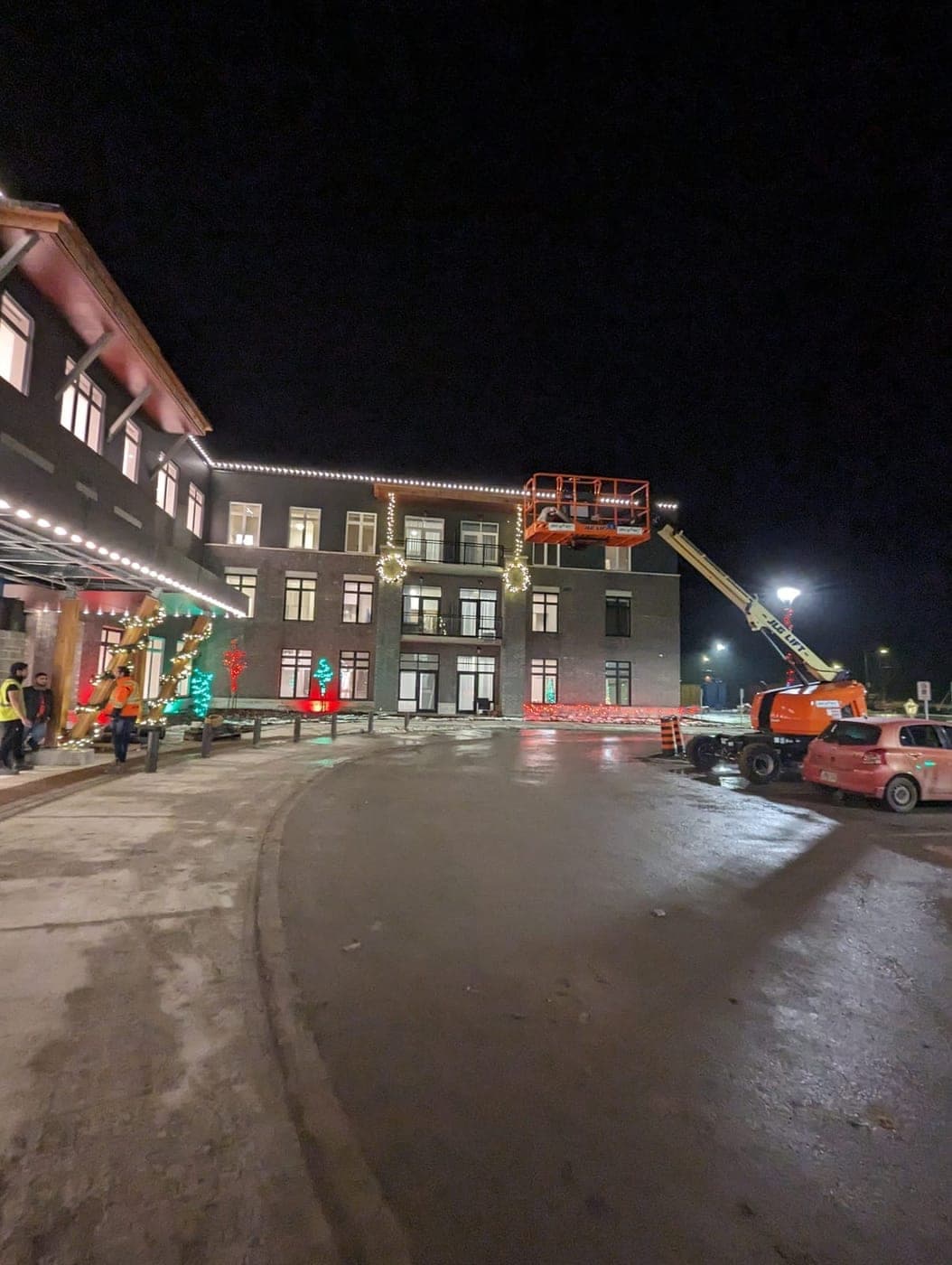
October is when the bucket trucks and aerial lifts go out. Exterior work goes first because it is weather dependent and because rooflines, columns, porte-cochères and wrapped trees take the most crew hours. Installing in October means the work is done in milder weather and daylight, and the display simply stays off on the timer until you want it lit.
Properties that insist on a late install often end up paying for it in a different way: rushed crews, fewer date choices and a display that goes up in sleet. Our commercial-grade LED strings and C9 bulbs are built to sit on a roofline through winter, so there is no downside to installing early and lighting later.
After-hours and overnight installs are normal in October for hotels, condos and plazas. We agree a window with your building staff, cone off only the area we are working in, and keep guest arrivals, deliveries and parking moving. If a property has light daytime traffic, a daytime install is faster and we will say so.
November: lobbies, atriums and the Black Friday deadline
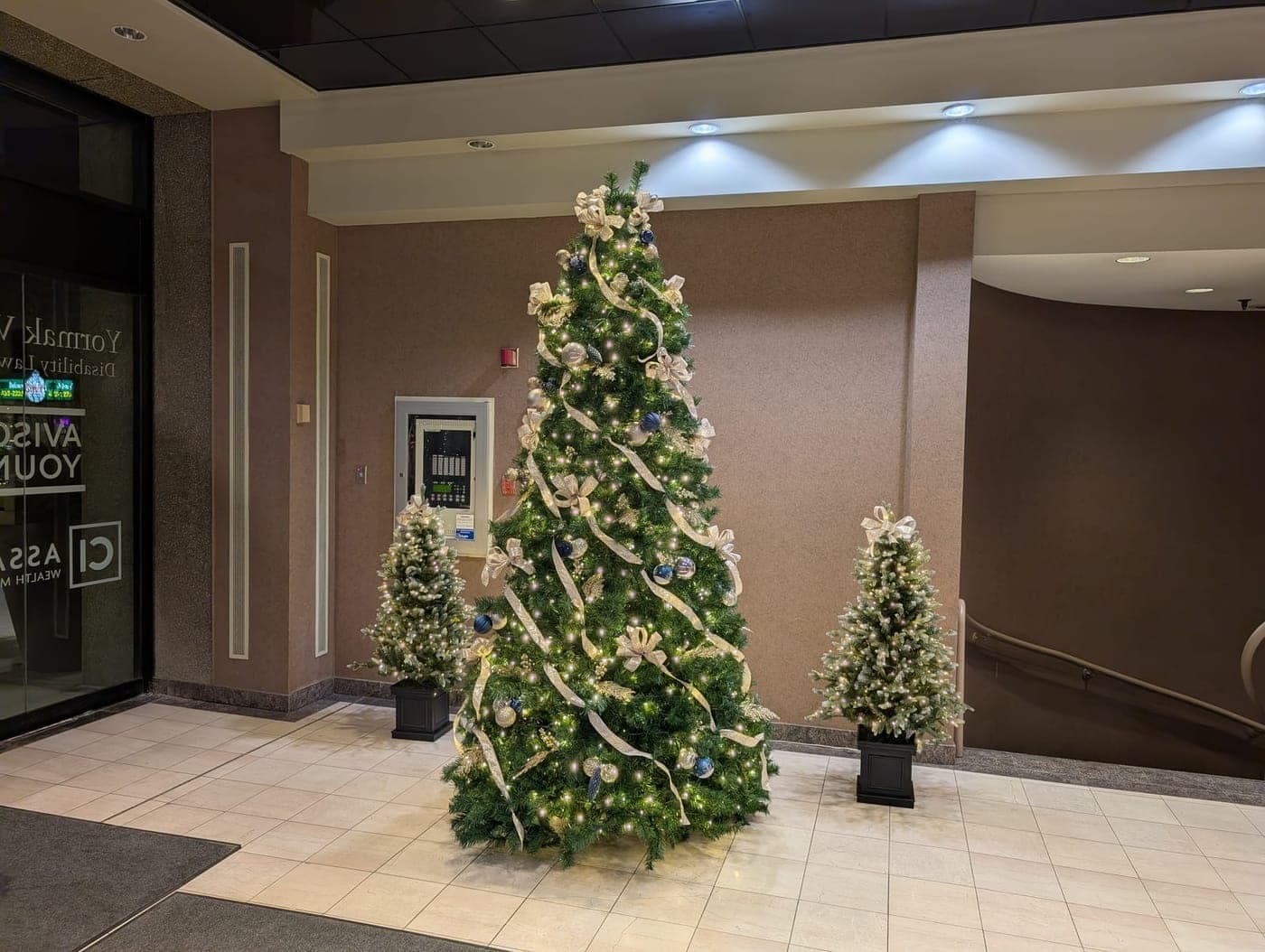
Interior work fills November. Pre-lit lobby trees from 7 to 20 feet, elevator-lobby trees, staircase and railing garland, entrance arches, wreaths and planters go in once the exterior is done. Interior installs are usually overnight for hotels and shopping centres so guests and shoppers arrive to a finished display, and after hours for office towers and condos.
The deadline that drives the month is late November. Retail properties want to be lit before Black Friday. Hotels want the lobby done before holiday party season starts. Office towers want tenants to walk in to a decorated lobby on the first of December. We schedule to hit those dates, which is why early booking matters so much.
The last thing the crew does on every install is test every circuit, set every timer and walk the display with you or your staff. You get a contact for the season. From that point, the display is our responsibility to keep lit. Staff do not need to switch anything on or off, and timer changes for a tenant event are one phone call.
December: maintenance you should not have to think about
Season-long maintenance is included in every program at no charge for any fault. In practice that means a tripped GFCI, a timer knocked out of sync after the time change, a plug pulled by a snowplow or a tree section that goes dark gets fixed when you call. On larger programs we also do our own drive-by checks so many faults are fixed before anyone notices.
Because everything is our own inventory, the truck carries matching replacement strings, bulbs and timers. There is no waiting for a part or arguing about whose product failed. That is the main reason we do not install customer-supplied lights: we cannot warranty product we did not source and test. It also means repairs match the rest of the display instead of standing out.
December is also when properties ask for small changes: lights on later for a tenant event, a tree moved for a photo day, a wreath added at a side entrance. Timer changes are part of the program. Design changes are quoted separately and done quickly. Tell us a day ahead where you can and we will fit it into the route.
January: takedown, labelling and storage
Takedown runs through the first three weeks of January. The same crews with the same lifts remove the display, after hours where needed, and pack everything by property and location. Exterior strings are tested, coiled and tagged by run. Lobby trees come down in sections. Ornaments and ribbon are boxed so the same scheme can go back up next year without a redesign.
Everything goes to our warehouse. Labelled storage is included whether you lease the decor or own it and pay for the service program. You get your mechanical room and storage cage back and nobody on your staff has to carry boxes to a basement. If you want plain warm-white lighting kept up as winter lighting into February or March, tell us at quoting time and we plan the takedown around it.
Takedown is also when we note what to improve: a roofline that needs an outlet added, a tree that has outgrown its wrap, a lobby that could take a taller tree. Those notes go into your file for next season's proposal. By the time we meet in summer, the plan for the coming season is already half written.
Winter and spring: rebooking and multi-year agreements
Returning clients get priority dates the next season. A multi-year agreement goes further: it locks pricing and the install and takedown schedule for the term, reserves your product in our warehouse and lets you set the holiday budget once. For hotels, property management portfolios and BIAs that need a predictable number every year, this is the simplest way to run the program.
If you want to change the look, late winter is the time to say so. A refresh on a leased lobby tree, from gold and warm white to blue and silver for example, is a design change rather than a purchase. Adding scope, such as wrapping more boulevard trees or lighting a second entrance, is quoted as an addition while the rest of the agreement stays as is.
Call 519-266-6796 or send a request and we reply within one business day. The earlier in the year you start, the more of this timeline works in your favour. If you are reading this in July, you are right on time. If you are reading it in November, call anyway and we will tell you what is still possible this season and hold your dates for the next.